Tokenomins
$ROKZ is the native coordination asset of Rokz Protocol.
It is designed to align deterministic execution demand, Rokz Client participation, state verification, private transaction processing, native liquidity coordination, ecosystem growth, and long-term protocol governance around a single infrastructure-native asset.
Rokz is not a DEX, bridge, aggregator, router, or solver network. Therefore, $ROKZ is not structured as a venue token or routing-fee token. Its design is tied to the protocol’s core function: coordinating deterministic execution across fragmented blockchain environments.
$ROKZ is designed to follow infrastructure usage, not speculative market timing. Token distribution, vesting, and release mechanics should align with protocol maturity, Rokz Client participation, execution volume, and ecosystem adoption.
Token Allocation
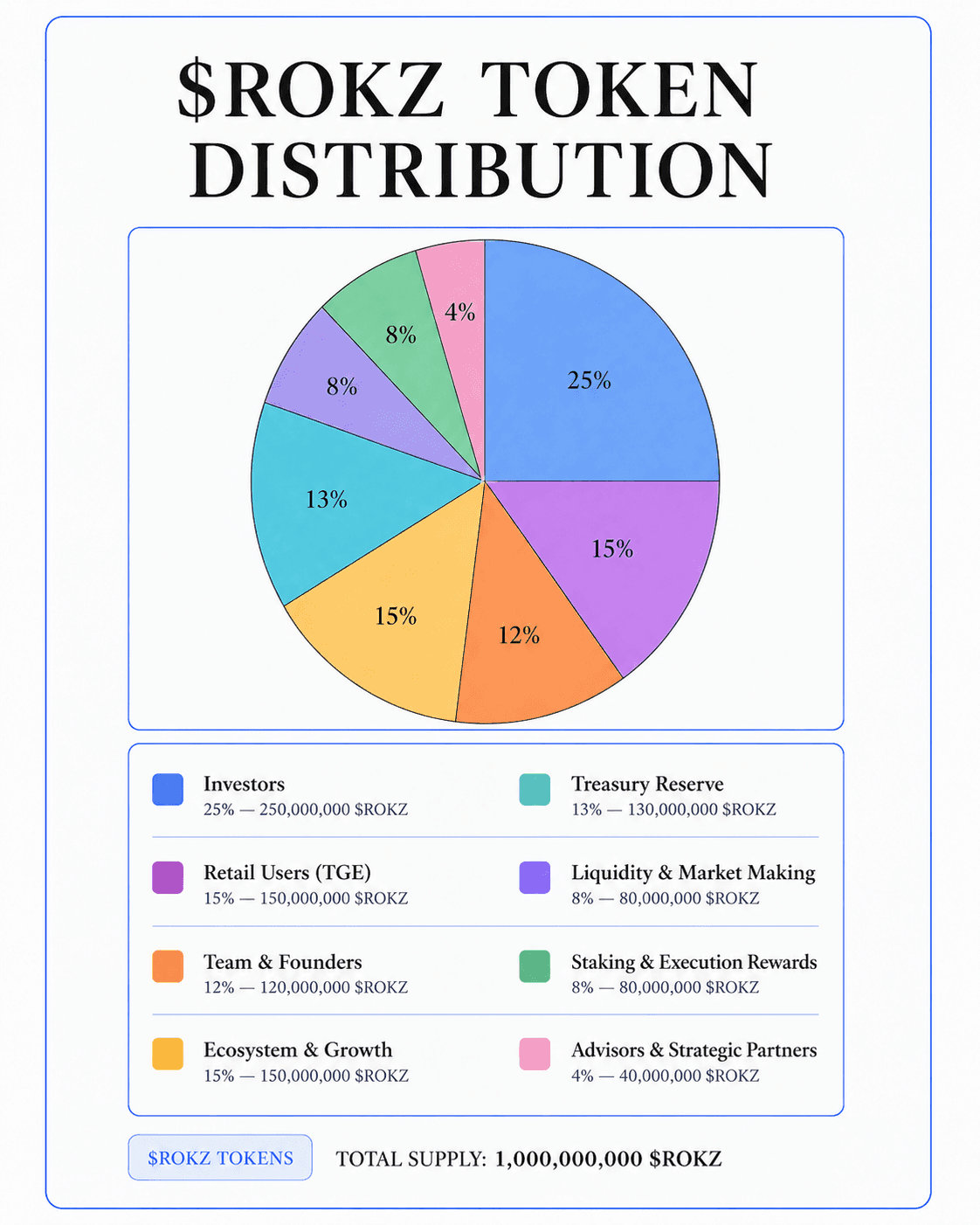
The total fixed supply of $ROKZ is:
Liquidity & Market Making
Staking & Execution Rewards
Advisors & Strategic Partners
100% — 1,000,000,000 $ROKZ
Liquidity & Market Making
Staking & Execution Rewards
Advisors & Strategic Partners
100% — 1,000,000,000 $ROKZ
The allocation is designed to support three parallel objectives: capital formation, execution-layer security, and ecosystem expansion. Long-term categories such as Team, Treasury, Ecosystem, and Client Rewards should be released progressively as the protocol matures.
Investors — 25%: Supports strategic
capitalization, institutional alignment,
and long-term network development.
Retail Users — TGE — 15%: Provides
early community access and public
market participation at token
generation.
Retail Users — TGE — 15%:
Team & Founders — 12%: Aligns
core contributors with long-term
protocol execution, subject to
extended vesting.
Ecosystem & Growth — 15%: Funds
integrations, developers, liquidity partners,
user acquisition, ecosystem grants,
and adoption programs.
Ecosystem & Growth — 15%:
Treasury Reserve — 13%: Supports
long-term protocol resilience,
security, audits, ecosystem strategy,
and governance-controlled initiatives.
Liquidity & Market Making — 8%:
Supports market depth, exchange
liquidity, price stability, and initial
liquidity operations.
Liquidity & Market Making — 8%:
Staking & Execution Rewards — 8%:
Incentivizes Rokz Client participation,
state verification, execution readiness,
and network security.
Staking & Execution Rewards — 8%:
Staking & Execution Rewards — 8%:
Aligns strategic contributors,
technical advisors, institutional
partners, and ecosystem
development participants.
Advisors & Strategic Partners — 4%:
Investors — 25%: Supports strategic capitalization, institutional alignment, and long-term network development.
Investors — 25%: Supports strategic capitalization, institutional alignment, and
long-term network development.
Retail Users — TGE — 15%: Provides early community access and public market participation at token generation.
Retail Users — TGE — 15%:
Retail Users — TGE — 15%: Provides early community access and public market
participation at token generation.
Retail Users — TGE — 15%:
Team & Founders — 12%: Aligns core contributors with long-term protocol execution, subject to extended vesting.
Team & Founders — 12%: Aligns core contributors with long-term protocol execution,
subject to extended vesting.
Ecosystem & Growth — 15%: Funds integrations, developers, liquidity partners, user acquisition, ecosystem grants, and adoption programs.
Ecosystem & Growth — 15%:
Treasury Reserve — 13%: Supports long-term protocol resilience, security, audits, ecosystem strategy, and governance-controlled initiatives.
Treasury Reserve — 13%: Supports long-term protocol resilience, security, audits,
ecosystem strategy, and governance-controlled initiatives.
Liquidity & Market Making — 8%: Supports market depth, exchange liquidity, price stability, and initial liquidity operations.
Liquidity & Market Making — 8%:
Liquidity & Market Making — 8%: Supports market depth, exchange liquidity, price
stability, and initial liquidity operations.
Liquidity & Market Making — 8%:
Staking & Execution Rewards — 8%: Incentivizes Rokz Client participation, state verification, execution readiness, and network security.
Staking & Execution Rewards — 8%:
Staking & Execution Rewards — 8%: Incentivizes Rokz Client participation, state
verification, execution readiness, and network security.
Staking & Execution Rewards — 8%:
Staking & Execution Rewards — 8%: Aligns strategic contributors, technical advisors, institutional partners, and ecosystem development participants.
Advisors & Strategic Partners — 4%:
Large allocations without long-term lockups can create structural sell pressure. $ROKZ allocation categories should be governed by vesting, milestone-based releases, and protocol maturity conditions.
Vesting & Unlock Schedule
The $ROKZ unlock framework is designed to protect the protocol from short-term supply shocks while aligning contributors, investors, operators, and ecosystem participants with long-term infrastructure growth.
The core principle is simple:
Token unlocks should follow infrastructure maturity, not speculative market timing.
Team tokens are subject to long-term vesting. Investor allocations unlock gradually. Ecosystem incentives are released based on measurable adoption milestones. Rokz Client rewards are tied to verified network participation, uptime, execution readiness, and state-verification performance.
12-month cliff, followed by 36–48 months linear vesting to ensure long-term contributor alignment.
6–12 month cliff, followed by 24–36 months gradual vesting to reduce early market pressure.
Usage-based release, distributed over multiple years through integrations, grants, liquidity programs, and adoption milestones.
Staking & Execution Rewards
Performance-based release, distributed continuously based on Rokz Client participation, uptime, verified state activity, and execution contribution.
Governance-controlled, released over the long term for security, ecosystem growth, liquidity strategy, and protocol resilience.
Available at token generation according to public distribution parameters and launch mechanics.
Liquidity & Market Making
Released according to exchange liquidity needs, market-making agreements, and treasury-approved liquidity strategy.
Advisors & Strategic Partners
Subject to structured vesting, milestone-based participation, and long-term contribution alignment.
12-month cliff, followed by 36–48 months linear vesting to ensure long-term contributor alignment.
6–12 month cliff, followed by 24–36 months gradual vesting to reduce early market pressure.
Usage-based release, distributed over multiple years through integrations, grants, liquidity programs, and adoption milestones.
Staking & Execution Rewards
Performance-based release, distributed continuously based on Rokz Client participation, uptime, verified state activity, and execution contribution.
Governance-controlled, released over the long term for security, ecosystem growth, liquidity strategy, and protocol resilience.
Available at token generation according to public distribution parameters and launch mechanics.
Liquidity & Market Making
Released according to exchange liquidity needs, market-making agreements, and treasury-approved liquidity strategy.
Advisors & Strategic Partners
Subject to structured vesting, milestone-based participation, and long-term contribution alignment.
The vesting model is designed to reduce short-term supply pressure by locking long-term contributors, gradually unlocking investor allocations, and releasing ecosystem incentives only when they support measurable protocol growth.
The vesting model is designed around five objectives:
Prevent early supply shocks:
Large allocations should not enter
circulation immediately after launch.
Prevent early supply shocks:
Align long-term contributors: Team,
founder, advisor, and strategic
partner allocations should vest over
extended periods.
Align long-term contributors:
Reward real network growth:
Ecosystem and Client rewards should
follow adoption, integrations,
execution volume, and verified
infrastructure participation.
Reward real network growth:
Preserve treasury flexibility:
Treasury reserves should remain
long-term and
governance-controlled.
Preserve treasury flexibility:
Support institutional confidence:
Clear unlock discipline reduces
uncertainty for investors, partners,
and ecosystem participants.
Support institutional confidence:
Prevent early supply shocks: Large allocations should not enter circulation immediately after launch.
Prevent early supply shocks:
Align long-term contributors: Team, founder, advisor, and strategic partner allocations should vest over extended periods.
Align long-term contributors:
Reward real network growth: Ecosystem and Client rewards should follow adoption, integrations, execution volume, and verified infrastructure participation.
Reward real network growth:
Preserve treasury flexibility: Treasury reserves should remain long-term and governance-controlled.
Preserve treasury flexibility:
Support institutional confidence: Clear unlock discipline reduces uncertainty for investors, partners, and ecosystem participants.
Support institutional confidence:
A token schedule based only on time can release supply before the protocol has reached sufficient adoption. Rokz should prioritize usage-linked and milestone-linked releases wherever possible.
Usage-Aligned Unlocks
$ROKZ release is designed to follow protocol adoption, Rokz Client participation, execution volume, and ecosystem growth.
Tokens should not be released purely by calendar time. Where possible, token releases should be tied to measurable infrastructure milestones.
The release philosophy is:
No growth ⟶ limited release.
More execution usage ⟶ more incentives unlocked.
This creates a token model where supply expansion is connected to real protocol progress rather than passive emission.
Usage-aligned release means token distribution should be connected to measurable network contribution: execution volume, verified state submissions, Rokz Client uptime, ecosystem integrations, API usage, native liquidity readiness, and institutional adoption.
Rokz Client Participation
Client reward allocations unlock as operators provide verified state, uptime, liquidity checks, finality monitoring, and execution readiness.
Execution-linked incentives unlock as deterministic transaction volume increases across supported environments.
Ecosystem allocations unlock when wallets, protocols, liquidity partners, and institutional systems integrate Rokz infrastructure.
Token incentives may support new chain integrations, native liquidity endpoints, and cross-network execution environments.
Grants and developer rewards unlock based on SDK usage, API integrations, tooling contributions, and ecosystem applications.
B2B and API-related incentives may unlock as institutional execution demand, reporting, and private execution access scale.
Treasury or ecosystem allocations may support audits, bug bounties, formal verification, and Client security tooling.
Liquidity incentives may unlock when target-side native liquidity becomes execution-ready and verifiable by Rokz Clients.
Prevent immediate unlocks for long-term contributors and strategic holders.
Smooths supply release over extended periods.
Links ecosystem and growth allocations to real network progress.
Performance-Based Rewards
Releases Client rewards only for verified participation and execution contribution.
Allows the protocol to adjust release parameters as network conditions evolve.
Prevents uncontrolled treasury distribution and preserves long-term reserves.
Enables governance or security processes to pause releases during critical risk events.
1 — Verified Expected Outcome
Rokz creates a verified execution snapshot before native execution begins.
The transaction is executed against verified local liquidity conditions.
If the actual execution result is better than the verified expected result, the difference is identified as positive execution surplus.
The surplus value is converted into $ROKZ through the protocol buyback module.
The user receives the acquired $ROKZ as a locked reward.
Rewarded $ROKZ remains locked for 2 months after allocation before becoming claimable.
Actual execution value is higher than verified expected value
Positive surplus is generated and may be converted into locked $ROKZ rewards.
Actual execution value equals verified expected value
No surplus reward is generated.
Actual execution value is below verified expected value
Execution should follow protocol-defined protection logic, including abort, re-verification, retry, or other risk controls.
Positive execution improvement can be captured by hidden spreads, solvers, routers, or intermediaries.
Positive execution surplus can be converted into $ROKZ and credited to the user as a locked reward.
Execution improvement remains opaque.
Execution improvement becomes measurable and token-linked.
Users receive limited participation in upside.
Users can participate in better-than-expected execution outcomes.
Short-term value is extracted externally.
Surplus value can be recycled into long-term protocol alignment.
Users can see allocated $ROKZ rewards after surplus conversion.
Rewards remain non-transferable and non-claimable for 2 months after allocation.
Rewards become claimable only after the lock period ends.
Locking reduces immediate sell pressure and aligns users with continued protocol growth.
Creates measurable surplus against the verified expected outcome.
Recycles execution surplus into $ROKZ demand.
Aligns users with protocol growth over time.
Reduces hidden spread capture and improves trust in execution quality.
Connects transaction performance with token utility and user participation.
Rokz Client Participation
Client reward allocations unlock as operators provide verified state, uptime, liquidity checks, finality monitoring, and execution readiness.
Execution-linked incentives unlock as deterministic transaction volume increases across supported environments.
Ecosystem allocations unlock when wallets, protocols, liquidity partners, and institutional systems integrate Rokz infrastructure.
Token incentives may support new chain integrations, native liquidity endpoints, and cross-network execution environments.
Grants and developer rewards unlock based on SDK usage, API integrations, tooling contributions, and ecosystem applications.
B2B and API-related incentives may unlock as institutional execution demand, reporting, and private execution access scale.
Treasury or ecosystem allocations may support audits, bug bounties, formal verification, and Client security tooling.
Liquidity incentives may unlock when target-side native liquidity becomes execution-ready and verifiable by Rokz Clients.
Rokz Client Participation
Client reward allocations unlock as operators provide verified state, uptime, liquidity checks, finality monitoring, and execution readiness.
Execution-linked incentives unlock as deterministic transaction volume increases across supported environments.
Ecosystem allocations unlock when wallets, protocols, liquidity partners, and institutional systems integrate Rokz infrastructure.
Token incentives may support new chain integrations, native liquidity endpoints, and cross-network execution environments.
Grants and developer rewards unlock based on SDK usage, API integrations, tooling contributions, and ecosystem applications.
B2B and API-related incentives may unlock as institutional execution demand, reporting, and private execution access scale.
Treasury or ecosystem allocations may support audits, bug bounties, formal verification, and Client security tooling.
Liquidity incentives may unlock when target-side native liquidity becomes execution-ready and verifiable by Rokz Clients.
The token release framework should prioritize:
Execution infrastructure: Rewards
should support the systems that
make deterministic execution
possible.
Execution infrastructure:
Rokz Client performance: Emissions
should reward accurate verification,
uptime, low-latency state reporting,
and valid execution participation.
Native liquidity readiness:
Incentives should support liquidity
that is actually usable for execution,
not passive TVL.
Native liquidity readiness:
Ecosystem integrations:
Tokens should help onboard
protocols, wallets, developers, and
institutional interfaces.
Security and resilience: Treasury
and incentive allocations should
preserve the protocol’s ability to
withstand infrastructure, security,
and settlement risks.
Execution infrastructure: Rewards should support the systems that make deterministic execution possible.
Execution infrastructure:
Rokz Client performance: Emissions should reward accurate verification, uptime, low-latency state reporting, and valid execution participation.
Rokz Client performance: Emissions should reward accurate verification, uptime,
low-latency state reporting, and valid execution participation.
Native liquidity readiness: Incentives should support liquidity that is actually usable for execution, not passive TVL.
Native liquidity readiness:
Ecosystem integrations: Tokens should help onboard protocols, wallets, developers, and institutional interfaces.
Ecosystem integrations: Tokens should help onboard protocols, wallets, developers,
and institutional interfaces.
Security and resilience: Treasury and incentive allocations should preserve the protocol’s ability to withstand infrastructure, security, and settlement risks.
Security and resilience: Treasury and incentive allocations should preserve the
protocol’s ability to withstand infrastructure, security, and settlement risks.
$ROKZ release should reward infrastructure contribution before passive participation. The highest-value emissions are those that increase deterministic execution capacity, verified state coverage, native liquidity readiness, and protocol security.
Token Release Controls
To prevent excessive supply expansion, $ROKZ release should be governed through protocol-defined controls.
These controls help ensure that token distribution remains aligned with execution demand and network maturity.
Prevent immediate unlocks for long-term contributors and strategic holders.
Smooths supply release over extended periods.
Links ecosystem and growth allocations to real network progress.
Performance-Based Rewards
Releases Client rewards only for verified participation and execution contribution.
Allows the protocol to adjust release parameters as network conditions evolve.
Prevents uncontrolled treasury distribution and preserves long-term reserves.
Enables governance or security processes to pause releases during critical risk events.
Prevent immediate unlocks for long-term contributors and strategic holders.
Smooths supply release over extended periods.
Links ecosystem and growth allocations to real network progress.
Performance-Based Rewards
Releases Client rewards only for verified participation and execution contribution.
Allows the protocol to adjust release parameters as network conditions evolve.
Prevents uncontrolled treasury distribution and preserves long-term reserves.
Enables governance or security processes to pause releases during critical risk events.
Token emissions that are not tied to usage, security, liquidity readiness, or execution contribution can create inflation without strengthening the protocol. $ROKZ release should remain utility-driven.
Investor Alignment
The $ROKZ tokenomics framework is designed to be legible to institutional investors.
The key investor-facing principles are:
Fixed supply: Total token supply is
capped at 1,000,000,000 $ROKZ.
Long-term contributor alignment:
Team and founder allocations vest
over multiple years.
Long-term contributor alignment:
Gradual investor unlocks: Investor
supply enters circulation
progressively, not immediately.
Gradual investor unlocks:
Usage-linked ecosystem release:
Ecosystem allocations are designed
to follow integrations, adoption, and
execution volume.
Usage-linked ecosystem release:
Performance-based Client rewards:
Rokz Client incentives are tied to
network participation and verified
execution infrastructure.
Performance-based Client rewards:
Governance-controlled treasury:
Treasury reserves remain available
for long-term protocol growth and
risk management.
Governance-controlled treasury:
Execution-driven token economy:
$ROKZ utility is connected to
deterministic execution demand, not
speculative token emissions.
Execution-driven token economy:
Fixed supply: Total token supply is capped at 1,000,000,000 $ROKZ.
Long-term contributor alignment: Team and founder allocations vest over multiple years.
Long-term contributor alignment:
Long-term contributor alignment: Team and founder allocations vest over multiple
years.
Long-term contributor alignment:
Gradual investor unlocks: Investor supply enters circulation progressively, not immediately.
Gradual investor unlocks:
Gradual investor unlocks: Investor supply enters circulation progressively, not
immediately.
Gradual investor unlocks:
Usage-linked ecosystem release: Ecosystem allocations are designed to follow integrations, adoption, and execution volume.
Usage-linked ecosystem release:
Usage-linked ecosystem release: Ecosystem allocations are designed to follow
integrations, adoption, and execution volume.
Usage-linked ecosystem release:
Performance-based Client rewards: Rokz Client incentives are tied to network participation and verified execution infrastructure.
Performance-based Client rewards:
Performance-based Client rewards: Rokz Client incentives are tied to network
participation and verified execution infrastructure.
Performance-based Client rewards:
Governance-controlled treasury: Treasury reserves remain available for long-term protocol growth and risk management.
Governance-controlled treasury:
Governance-controlled treasury: Treasury reserves remain available for long-term
protocol growth and risk management.
Governance-controlled treasury:
Execution-driven token economy: $ROKZ utility is connected to deterministic execution demand, not speculative token emissions.
Execution-driven token economy:
The strongest token economies are built around real infrastructure demand. $ROKZ tokenomics are designed to connect supply release, network security, execution volume, Client participation, and ecosystem expansion into one coherent protocol economy.
$ROKZ Execution Rewards
Rokz Protocol is designed to connect execution quality, protocol usage, user alignment, and long-term $ROKZ demand through two complementary mechanisms:
Positive Slippage Surplus Buyback:
Converts better-than-expected
execution outcomes into locked
$ROKZ rewards for users.
Positive Slippage Surplus Buyback:
Protocol Revenue Buyback:
Allocates a defined share of net
protocol revenue toward $ROKZ
buybacks through
governance-controlled mechanisms.
Protocol Revenue Buyback:
Positive Execution Surplus Buyback: Converts better-than-expected execution outcomes into locked $ROKZ rewards for users.
Positive Execution Surplus Buyback:
Positive Execution Surplus Buyback: Converts better-than-expected execution outcomes
into locked $ROKZ rewards for users.
Positive Execution Surplus Buyback:
Protocol Revenue Buyback Allocation: Allocates a defined share of net protocol revenue toward $ROKZ buybacks through governance-controlled mechanisms.
Protocol Revenue Buyback Allocation:
Together, these mechanisms are designed to ensure that execution improvement and protocol revenue do not disappear into hidden spreads, intermediary capture, or fragmented execution layers. Instead, value created by Rokz execution can be redirected into long-term protocol alignment.
Rokz is designed to make execution quality measurable, user-aligned, and token-linked. When the protocol creates execution value, that value can be recycled into $ROKZ demand, user rewards, Client incentives, treasury reserves, safety modules, or ecosystem growth.
Positive Slippage Buyback
Rokz Protocol is designed to turn positive execution improvement into long-term protocol alignment.
When a transaction executes better than the verified expected outcome, the difference is treated as positive execution surplus. Instead of allowing this surplus to be captured by intermediaries, routers, solvers, or hidden execution layers, Rokz can convert the surplus into $ROKZ through the protocol’s buyback mechanism and automatically credit the user with locked $ROKZ rewards.
The credited $ROKZ is locked for 2 months from the moment of allocation.
This mechanism aligns three core objectives:
Users receive upside from
better-than-expected execution.
Positive execution value is recycled
into $ROKZ demand.
Rewards are time-locked to support
long-term protocol alignment.
Users receive upside from better-than-expected execution.
Positive execution value is recycled into $ROKZ demand.
Rewards are time-locked to support long-term protocol alignment instead of short-term extraction.
Rewards are time-locked to support long-term protocol alignment.
Positive execution surplus occurs when the actual execution result is better than the verified expected result established before native execution begins. Rokz treats this surplus as measurable execution improvement, not as hidden spread.
1 — Verified Expected Outcome
Rokz creates a verified execution snapshot before native execution begins.
The transaction is executed against verified local liquidity conditions.
If the actual execution result is better than the verified expected result, the difference is identified as positive execution surplus.
The surplus value is converted into $ROKZ through the protocol buyback module.
The user receives the acquired $ROKZ as a locked reward.
Rewarded $ROKZ remains locked for 2 months after allocation before becoming claimable.
1 — Verified Expected Outcome
Rokz creates a verified execution snapshot before native execution begins.
The transaction is executed against verified local liquidity conditions.
If the actual execution result is better than the verified expected result, the difference is identified as positive execution surplus.
The surplus value is converted into $ROKZ through the protocol buyback module.
The user receives the acquired $ROKZ as a locked reward.
Rewarded $ROKZ remains locked for 2 months after allocation before becoming claimable.
Positive execution improvement should not be captured by hidden execution layers. Rokz can redirect better-than-expected execution outcomes back to users through locked $ROKZ rewards.
Execution Slippage Surplus Formula
The positive execution surplus is calculated as:
Positive Execution Surplus = Actual Execution Value − Verified Expected Execution Value
If the result is positive:
Positive Surplus ⟶ $ROKZ Buyback ⟶ Locked User Reward
If there is no positive surplus:
No surplus reward is generated
Actual execution value is higher than verified expected value
Positive surplus is generated and may be converted into locked $ROKZ rewards.
Actual execution value equals verified expected value
No surplus reward is generated.
Actual execution value is below verified expected value
Execution should follow protocol-defined protection logic, including abort, re-verification, retry, or other risk controls.
Actual execution value is higher than verified expected value
Positive surplus is generated and may be converted into locked $ROKZ rewards.
Actual execution value equals verified expected value
No surplus reward is generated.
Actual execution value is below verified expected value
Execution should follow protocol-defined protection logic, including abort, re-verification, retry, or other risk controls.
Positive execution surplus is conditional. It only exists when execution performs better than the verified expected baseline. Users should not treat surplus rewards as guaranteed yield, fixed income, or automatic distribution.
In traditional DeFi, execution improvement is often captured by external actors, hidden spreads, routers, solvers, or intermediaries.
Positive execution performance becomes a user-aligned protocol mechanism. When Rokz execution produces a better outcome than the verified baseline, the user participates in that upside through locked $ROKZ rewards.
This creates a cleaner execution economy:
positive surplus is not extracted by intermediaries;
execution quality creates protocol-aligned demand;
users are rewarded for better-than-expected outcomes;
rewards remain locked to reduce short-term sell pressure;
$ROKZ becomes directly connected to execution performance.
Positive execution improvement can be captured by hidden spreads, solvers, routers, or intermediaries.
Positive execution surplus can be converted into $ROKZ and credited to the user as a locked reward.
Execution improvement remains opaque.
Execution improvement becomes measurable and token-linked.
Users receive limited participation in upside.
Users can participate in better-than-expected execution outcomes.
Short-term value is extracted externally.
Surplus value can be recycled into long-term protocol alignment.
Positive execution improvement can be captured by hidden spreads, solvers, routers, or intermediaries.
Positive execution surplus can be converted into $ROKZ and credited to the user as a locked reward.
Execution improvement remains opaque.
Execution improvement becomes measurable and token-linked.
Users receive limited participation in upside.
Users can participate in better-than-expected execution outcomes.
Short-term value is extracted externally.
Surplus value can be recycled into long-term protocol alignment.
Rokz turns execution improvement into measurable protocol value. Better execution is not hidden in backend spread capture; it can become user-aligned $ROKZ demand.
Locked $ROKZ rewards are subject to a fixed 2-month lock period from the moment they are credited.
During the lock period, rewards may be visible in the user’s account but are not transferable or claimable until the unlock date.
Reward Credited ⟶ 2-Month Lock ⟶ Claimable $ROKZ
The lock design supports long-term alignment between users and the Rokz execution layer.
Users can see allocated $ROKZ rewards after surplus conversion.
Rewards remain non-transferable and non-claimable for 2 months after allocation.
Rewards become claimable only after the lock period ends.
Locking reduces immediate sell pressure and aligns users with continued protocol growth.
Users can see allocated $ROKZ rewards after surplus conversion.
Rewards remain non-transferable and non-claimable for 2 months after allocation.
Rewards become claimable only after the lock period ends.
Locking reduces immediate sell pressure and aligns users with continued protocol growth.
The lock period is designed to prevent immediate extraction and support longer-term alignment between execution quality, user participation, and $ROKZ demand.
The Positive Execution Surplus Buyback mechanism transforms execution improvement into protocol value.
Instead of treating better execution as an invisible backend advantage, Rokz makes it measurable, user-aligned, and token-linked.
Better Execution ⟶ Positive Surplus ⟶ $ROKZ Buyback ⟶ Locked User Reward ⟶ Long-Term Protocol Alignment
Creates measurable surplus against the verified expected outcome.
Recycles execution surplus into $ROKZ demand.
Aligns users with protocol growth over time.
Reduces hidden spread capture and improves trust in execution quality.
Connects transaction performance with token utility and user participation.
Creates measurable surplus against the verified expected outcome.
Recycles execution surplus into $ROKZ demand.
Aligns users with protocol growth over time.
Reduces hidden spread capture and improves trust in execution quality.
Connects transaction performance with token utility and user participation.
The surplus mechanism should be implemented with transparent accounting, clear baseline definitions, and governance-approved parameters. Without clear measurement, surplus rewards can become difficult to audit.
Protocol Revenue Buyback
Rokz Protocol is designed to connect real execution demand with long-term $ROKZ alignment.
A defined share of protocol revenue may be allocated to $ROKZ buybacks through a governance-controlled buyback mechanism. The target allocation range is 15–20% of net protocol revenue, subject to final protocol governance, treasury policy, legal review, and network maturity.
This mechanism is designed to ensure that protocol usage, execution volume, API demand, B2B integrations, private execution access, and deterministic settlement activity can contribute directly to long-term $ROKZ demand.
The buyback allocation is based on net protocol revenue, not gross revenue. Infrastructure costs, gas liabilities, refunds, security reserves, partner obligations, and governance-approved operating allocations may be deducted before the buyback rate is applied.
Buybacks should be connected to real protocol usage: execution demand, API access, B2B integrations, private execution, deterministic settlement, and infrastructure activity.
The buyback allocation is calculated as:
Buyback Allocation = Net Protocol Revenue × Buyback Rate
Net Protocol Revenue = Gross Protocol Revenue
Partner / Integration Obligations
Governance-Approved Operating Allocations
Total revenue generated by Rokz from execution fees, API usage, B2B integrations, private execution access, gas abstraction, and premium coordination services.
Revenue remaining after required operating, infrastructure, security, refund, partner, and governance-approved obligations.
Target range of 15–20% applied to net protocol revenue.
The resulting amount allocated toward $ROKZ buybacks.
Total revenue generated by Rokz from execution fees, API usage, B2B integrations, private execution access, gas abstraction, and premium coordination services.
Revenue remaining after required operating, infrastructure, security, refund, partner, and governance-approved obligations.
Target range of 15–20% applied to net protocol revenue.
The resulting amount allocated toward $ROKZ buybacks.
Total revenue generated by Rokz from execution fees, API usage, B2B integrations, private execution access, gas abstraction, and premium coordination services.
Revenue remaining after required operating, infrastructure, security, refund, partner, and governance-approved obligations.
Target range of 15–20% applied to net protocol revenue.
The resulting amount allocated toward $ROKZ buybacks.
The 15–20% range should be treated as a target allocation framework, not an unconditional obligation. Final parameters may depend on governance, treasury policy, legal review, protocol maturity, and risk conditions.
Rokz revenue may originate from multiple infrastructure-driven channels.
Fees generated from deterministic native execution across supported networks.
Revenue from protocols, wallets, fintechs, and institutional systems accessing Rokz infrastructure.
Enterprise-grade access to Rokz execution, state verification, private flow, and settlement infrastructure.
Fees for protected intent processing, private execution lanes, and MEV-resistant execution flow.
Protocol fees connected to simplified cross-network gas and execution-cost management.
Premium Coordination Services
Advanced execution guarantees, priority coordination, reporting, and institutional execution modules.
Fees generated from deterministic native execution across supported networks.
Revenue from protocols, wallets, fintechs, and institutional systems accessing Rokz infrastructure.
Enterprise-grade access to Rokz execution, state verification, private flow, and settlement infrastructure.
Fees for protected intent processing, private execution lanes, and MEV-resistant execution flow.
Protocol fees connected to simplified cross-network gas and execution-cost management.
Premium Coordination Services
Advanced execution guarantees, priority coordination, reporting, and institutional execution modules.
Fees generated from deterministic native execution across supported networks.
Revenue from protocols, wallets, fintechs, and institutional systems accessing Rokz infrastructure.
Enterprise-grade access to Rokz execution, state verification, private flow, and settlement infrastructure.
Fees for protected intent processing, private execution lanes, and MEV-resistant execution flow.
Protocol fees connected to simplified cross-network gas and execution-cost management.
Premium Coordination Services
Advanced execution guarantees, priority coordination, reporting, and institutional execution modules.
Rokz revenue is designed to come from execution infrastructure usage, not speculative token activity. The stronger the protocol’s execution demand, the stronger the potential buyback base.
1 — Protocol Revenue Generated
Rokz generates revenue from execution fees, API usage, B2B integrations, and coordination services.
2 — Net Revenue Calculated
Required costs, reserves, refunds, security allocations, and partner obligations are deducted.
3 — Buyback Allocation Applied
15–20% of net protocol revenue is directed into the $ROKZ buyback allocation.
Buybacks may be executed through transparent market mechanisms, TWAP execution, auctions, or governance-approved liquidity venues.
Acquired $ROKZ may be directed to treasury reserves, ecosystem incentives, user rewards, safety modules, Client rewards, or burn mechanisms.
Premium Coordination Services
Advanced execution guarantees, priority coordination, reporting, and institutional execution modules.
1 — Protocol Revenue Generated
Rokz generates revenue from execution fees, API usage, B2B integrations, and coordination services.
2 — Net Revenue Calculated
Required costs, reserves, refunds, security allocations, and partner obligations are deducted.
3 — Buyback Allocation Applied
15–20% of net protocol revenue is directed into the $ROKZ buyback allocation.
Buybacks may be executed through transparent market mechanisms, TWAP execution, auctions, or governance-approved liquidity venues.
Acquired $ROKZ may be directed to treasury reserves, ecosystem incentives, user rewards, safety modules, Client rewards, or burn mechanisms.
Parameters remain adjustable through governance as protocol volume, risk profile, and ecosystem maturity evolve.
1 — Protocol Revenue Generated
Rokz generates revenue from execution fees, API usage, B2B integrations, and coordination services.
2 — Net Revenue Calculated
Required costs, reserves, refunds, security allocations, and partner obligations are deducted.
3 — Buyback Allocation Applied
15–20% of net protocol revenue is directed into the $ROKZ buyback allocation.
Buybacks may be executed through transparent market mechanisms, TWAP execution, auctions, or governance-approved liquidity venues.
Acquired $ROKZ may be directed to treasury reserves, ecosystem incentives, user rewards, safety modules, Client rewards, or burn mechanisms.
Parameters remain adjustable through governance as protocol volume, risk profile, and ecosystem maturity evolve.
Buybacks may be executed through market purchases, TWAP strategies, auctions, protocol-owned liquidity mechanisms, or other governance-approved execution methods. The selected method should minimize market disruption and maximize transparency.
The buyback allocation is not designed as a speculative token mechanic. It is designed as an infrastructure-alignment mechanism.
As Rokz execution demand grows, a portion of protocol revenue can be recycled into $ROKZ, reinforcing the connection between:
long-term network alignment.
This creates a usage-driven value loop:
Execution Demand ⟶ Protocol Revenue ⟶ 15–20% Buyback Allocation ⟶ $ROKZ Market Buybacks ⟶ Treasury / Rewards / Safety Module / Burn ⟶ Stronger Protocol Alignment
Strategic Alignment Model
Higher usage can increase protocol revenue and buyback capacity.
Revenue creates the economic base for buybacks, rewards, security, and ecosystem support.
Buybacks recycle protocol value into $ROKZ demand.
Stronger alignment can support more Clients, integrations, users, and liquidity readiness.
Treasury / Rewards / Safety Module / Burn
Acquired tokens can support long-term protocol resilience and alignment.
Strengthens long-term protocol balance sheet and strategic flexibility.
Funds locked $ROKZ rewards such as Positive Execution Surplus Buybacks.
Incentivizes accurate state verification, uptime, and execution readiness.
Supports risk backstop mechanisms for invalid state, settlement disputes, or Client failures.
Funds integrations, developers, liquidity partners, and institutional pilots.
May reduce supply if approved by governance and aligned with protocol sustainability.
Target range: 15–20% of net protocol revenue.
Buybacks may occur monthly, quarterly, or through volume-triggered epochs.
TWAP, auction, market purchase, protocol-owned liquidity strategy, or other governance-approved mechanisms.
Distribution across treasury, rewards, safety module, Client incentives, ecosystem programs, or burn.
Buybacks may be paused, reduced, or redirected during security events, market stress, treasury constraints, or governance-approved emergency periods.
Higher usage can increase protocol revenue and buyback capacity.
Revenue creates the economic base for buybacks, rewards, security, and ecosystem support.
Buybacks recycle protocol value into $ROKZ demand.
Treasury / Rewards / Safety Module / Burn
Acquired tokens can support long-term protocol resilience and alignment.
Stronger alignment can support more Clients, integrations, users, and liquidity readiness.
Higher usage can increase protocol revenue and buyback capacity.
Revenue creates the economic base for buybacks, rewards, security, and ecosystem support.
Buybacks recycle protocol value into $ROKZ demand.
Treasury / Rewards / Safety Module / Burn
Acquired tokens can support long-term protocol resilience and alignment.
Stronger alignment can support more Clients, integrations, users, and liquidity readiness.
The buyback mechanism is strongest when it is tied to real execution volume, protocol revenue, Client participation, and network maturity.
$ROKZ acquired through buybacks may be allocated across several protocol-controlled destinations.
Strengthens long-term protocol balance sheet and strategic flexibility.
Funds locked $ROKZ rewards such as Positive Execution Surplus Buybacks.
Incentivizes accurate state verification, uptime, and execution readiness.
Supports risk backstop mechanisms for invalid state, settlement disputes, or Client failures.
Funds integrations, developers, liquidity partners, and institutional pilots.
May reduce supply if approved by governance and aligned with protocol sustainability.
Strengthens long-term protocol balance sheet and strategic flexibility.
Funds locked $ROKZ rewards such as Positive Execution Surplus Buybacks.
Incentivizes accurate state verification, uptime, and execution readiness.
Supports risk backstop mechanisms for invalid state, settlement disputes, or Client failures.
Funds integrations, developers, liquidity partners, and institutional pilots.
May reduce supply if approved by governance and aligned with protocol sustainability.
Buyback-acquired $ROKZ does not need to follow one fixed destination. Governance may allocate tokens across treasury, rewards, Clients, safety modules, ecosystem growth, or burns depending on protocol conditions.
The buyback mechanism may be governed through protocol-defined parameters.
Target range: 15–20% of net protocol revenue.
Buybacks may occur monthly, quarterly, or through volume-triggered epochs.
TWAP, auction, market purchase, protocol-owned liquidity strategy, or other governance-approved mechanisms.
Distribution across treasury, rewards, safety module, Client incentives, ecosystem programs, or burn.
Buybacks may be paused, reduced, or redirected during security events, market stress, treasury constraints, or governance-approved emergency periods.
Target range: 15–20% of net protocol revenue.
Buybacks may occur monthly, quarterly, or through volume-triggered epochs.
TWAP, auction, market purchase, protocol-owned liquidity strategy, or other governance-approved mechanisms.
Distribution across treasury, rewards, safety module, Client incentives, ecosystem programs, or burn.
Buybacks may be paused, reduced, or redirected during security events, market stress, treasury constraints, or governance-approved emergency periods.
A buyback program without governance controls can become misaligned during market stress, security events, treasury constraints, or protocol risk periods. Rokz buybacks should remain adjustable through governance.
Compliance and Sustainability Note
The buyback mechanism should be structured as a protocol-level treasury and utility alignment mechanism, not as a guaranteed yield, dividend, or passive revenue entitlement.
Participation in $ROKZ does not automatically entitle holders to direct revenue distribution. Buyback parameters, allocation destinations, timing, and execution methods should remain subject to governance, compliance review, treasury policy, and protocol risk management.
$ROKZ participation should not be framed as guaranteed income or fixed return.
Holders do not automatically receive direct revenue distribution.
Governance-Controlled Parameters
Buyback rate, frequency, method, and allocation may be changed through governance.
Treasury and Legal Review
Buybacks should remain subject to treasury policy, legal review, and protocol risk management.
Buybacks should not compromise security, operations, Client rewards, reserves, or long-term protocol growth.
$ROKZ participation should not be framed as guaranteed income or fixed return.
Holders do not automatically receive direct revenue distribution.
Governance-Controlled Parameters
Buyback rate, frequency, method, and allocation may be changed through governance.
Treasury and Legal Review
Buybacks should remain subject to treasury policy, legal review, and protocol risk management.
Buybacks should not compromise security, operations, Client rewards, reserves, or long-term protocol growth.
$ROKZ participation should not be framed as guaranteed income or fixed return.
Holders do not automatically receive direct revenue distribution.
Governance-Controlled Parameters
Buyback rate, frequency, method, and allocation may be changed through governance.
Treasury and Legal Review
Buybacks should remain subject to treasury policy, legal review, and protocol risk management.
Buybacks should not compromise security, operations, Client rewards, reserves, or long-term protocol growth.
Buyback language should avoid implying dividends, guaranteed revenue share, fixed yield, or passive income rights. The mechanism should be described as a governance-controlled protocol alignment tool.
$ROKZ Token Utility
$ROKZ is the native coordination asset of Rokz Protocol.
It is designed to align execution demand, Rokz Client security, verified state synchronization, private transaction processing, native liquidity coordination, protocol governance, and ecosystem growth around one infrastructure-native utility layer.
Rokz is not a DEX, bridge, aggregator, router, or solver network. Therefore, $ROKZ is not designed as a venue token, routing-fee token, or speculative incentive layer. Its utility is tied to the protocol’s core function:
Deterministic transaction coordination across fragmented blockchain environments.
At the protocol level, $ROKZ supports six primary utility domains:
$ROKZ should be understood as an infrastructure coordination asset, not as a routing token, DEX token, bridge token, or speculative incentive layer. Its utility is tied to deterministic execution infrastructure.
$ROKZ is linked to execution coordination, verified state, Rokz Clients, native liquidity coordination, and protocol-level infrastructure alignment.
Execution Access
$ROKZ functions as an access asset for deterministic execution through Rokz Protocol.
Users, applications, wallets, protocols, and institutional systems may use $ROKZ to access:
private intent processing;
verified state synchronization;
deterministic execution triggering;
native liquidity coordination;
state-verified settlement;
priority execution lanes;
API-based execution infrastructure.
The objective is not to charge for simple transaction routing. Rokz does not route transactions. The objective is to price access to deterministic coordination infrastructure.
Enables access to Rokz Private Mempool and private pre-execution handling.
Verified Execution Access
Allows execution only after state, liquidity, price, finality, and constraints are verified.
Gives applications or institutions access to higher-throughput execution lanes.
Enables protocols, wallets, and B2B partners to integrate Rokz execution infrastructure.
Supports coordinated execution finality across heterogeneous environments.
Enables access to Rokz Private Mempool and private pre-execution handling.
Verified Execution Access
Allows execution only after state, liquidity, price, finality, and constraints are verified.
Gives applications or institutions access to higher-throughput execution lanes.
Enables protocols, wallets, and B2B partners to integrate Rokz execution infrastructure.
Supports coordinated execution finality across heterogeneous environments.
Enables access to Rokz Private Mempool and private pre-execution handling.
Verified Execution Access
Allows execution only after state, liquidity, price, finality, and constraints are verified.
Gives applications or institutions access to higher-throughput execution lanes.
Enables protocols, wallets, and B2B partners to integrate Rokz execution infrastructure.
Supports coordinated execution finality across heterogeneous environments.
$ROKZ is linked to execution coordination, not route discovery. Rokz does not monetize pathfinding. It prices access to deterministic coordination infrastructure.
$ROKZ should not be positioned as a token for route access, bridge usage, or intermediary fulfillment. Its utility is tied to verified execution infrastructure.
Client Staking & Security
Rokz Clients are the protocol’s local state-verification and execution-coordination infrastructure.
$ROKZ can be staked by Rokz Client operators to participate in the protocol’s verification, synchronization, and execution-readiness network. This creates cryptoeconomic alignment between Client operators and the integrity of the execution layer.
Staked $ROKZ may be used to:
qualify Client operators;
secure state verification;
align Client behavior with protocol rules;
back performance guarantees;
discourage invalid state reporting;
support slashing or penalty mechanisms for malicious or incorrect behavior;
determine Client participation tiers.
Rokz Client Security Model
Client operators stake $ROKZ to access verification responsibilities.
Staked Clients validate native liquidity conditions before execution.
Clients verify network-specific finality before settlement coordination.
Clients participate in deterministic snapshot construction.
Clients can trigger native execution only after protocol-defined readiness conditions.
Incorrect, malicious, or stale-state behavior may be penalized through protocol rules.
Client operators stake $ROKZ to access verification responsibilities.
Staked Clients validate native liquidity conditions before execution.
Clients verify network-specific finality before settlement coordination.
Clients participate in deterministic snapshot construction.
Clients can trigger native execution only after protocol-defined readiness conditions.
Incorrect, malicious, or stale-state behavior may be penalized through protocol rules.
Client operators stake $ROKZ to access verification responsibilities.
Staked Clients validate native liquidity conditions before execution.
Clients verify network-specific finality before settlement coordination.
Clients participate in deterministic snapshot construction.
Clients can trigger native execution only after protocol-defined readiness conditions.
Incorrect, malicious, or stale-state behavior may be penalized through protocol rules.
State Verification Utility
The most important utility of $ROKZ is its connection to verified state.
Rokz execution is not triggered because a path exists. It is triggered because execution conditions are verified. This makes state verification one of the protocol’s highest-value functions.
$ROKZ can be used to coordinate and incentivize:
deterministic snapshot construction;
Client performance scoring.
Confirms available native liquidity before execution.
Validates quote-to-execution integrity.
Confirms network-specific settlement readiness.
Checks whether the requested transaction can execute safely.
Confirms that all required domains are synchronized.
Ensures the final execution trigger is based on verified state.
Confirms available native liquidity before execution.
Validates quote-to-execution integrity.
Confirms network-specific settlement readiness.
Checks whether the requested transaction can execute safely.
Confirms that all required domains are synchronized.
Ensures the final execution trigger is based on verified state.
Confirms available native liquidity before execution.
Validates quote-to-execution integrity.
Confirms network-specific settlement readiness.
Checks whether the requested transaction can execute safely.
Confirms that all required domains are synchronized.
Ensures the final execution trigger is based on verified state.
Execution Utility Layer
$ROKZ functions as the infrastructure utility layer that connects gas abstraction, private execution, MEV protection, zero unexpected slippage, native liquidity coordination, institutional access, governance, safety backstops, ecosystem incentives, and protocol value alignment into one execution-native token model.
Rather than operating as a gas token for one chain, a routing token, or a speculative reward asset, $ROKZ is designed to support deterministic execution across fragmented blockchain environments by coordinating fees, access, verification, Client participation, liquidity readiness, and long-term protocol governance.
Supports unified execution-fee coordination across networks with different gas tokens, fee markets, RPC assumptions, transaction formats, and execution costs.
Private Execution & MEV Protection
Enables access to Rokz Private Mempool, protected intent handling, private execution lanes, and MEV-resistant native execution before transaction details become publicly exposed.
Supports execution against verified state, reducing unexpected quote-to-execution drift through state verification, re-verification, abort logic, and deterministic execution windows.
Native Liquidity Coordination
Aligns verified access to local liquidity pools without turning Rokz into a DEX, bridge, aggregator, or liquidity migration layer.
B2B & Institutional Access
Provides protocols, wallets, fintechs, trading systems, and institutions with API access, dedicated execution lanes, reporting, and private execution environments.
Governance & Risk Control
Enables governance over supported networks, Rokz Client standards, verification thresholds, fee parameters, slashing rules, treasury allocation, safety modules, and emergency controls.
Safety & Ecosystem Alignment
Supports risk backstops, Client accountability, liquidity partner incentives, developer grants, security programs, testnet participation, and long-term ecosystem growth.
Connects execution demand, protocol fees, Client rewards, treasury reserves, safety modules, buybacks, burns, and ecosystem expansion into a usage-based alignment model.
Supports unified execution-fee coordination across networks with different gas tokens, fee markets, RPC assumptions, transaction formats, and execution costs.
Private Execution & MEV Protection
Enables access to Rokz Private Mempool, protected intent handling, private execution lanes, and MEV-resistant native execution before transaction details become publicly exposed.
Supports execution against verified state, reducing unexpected quote-to-execution drift through state verification, re-verification, abort logic, and deterministic execution windows.
Native Liquidity Coordination
Aligns verified access to local liquidity pools without turning Rokz into a DEX, bridge, aggregator, or liquidity migration layer.
B2B & Institutional Access
Provides protocols, wallets, fintechs, trading systems, and institutions with API access, dedicated execution lanes, reporting, and private execution environments.
Governance & Risk Control
Enables governance over supported networks, Rokz Client standards, verification thresholds, fee parameters, slashing rules, treasury allocation, safety modules, and emergency controls.
Safety & Ecosystem Alignment
Supports risk backstops, Client accountability, liquidity partner incentives, developer grants, security programs, testnet participation, and long-term ecosystem growth.
Connects execution demand, protocol fees, Client rewards, treasury reserves, safety modules, buybacks, burns, and ecosystem expansion into a usage-based alignment model.
Supports unified execution-fee coordination across networks with different gas tokens, fee markets, RPC assumptions, transaction formats, and execution costs.
Private Execution & MEV Protection
Enables access to Rokz Private Mempool, protected intent handling, private execution lanes, and MEV-resistant native execution before transaction details become publicly exposed.
Supports execution against verified state, reducing unexpected quote-to-execution drift through state verification, re-verification, abort logic, and deterministic execution windows.
Native Liquidity Coordination
Aligns verified access to local liquidity pools without turning Rokz into a DEX, bridge, aggregator, or liquidity migration layer.
B2B & Institutional Access
Provides protocols, wallets, fintechs, trading systems, and institutions with API access, dedicated execution lanes, reporting, and private execution environments.
Governance & Risk Control
Enables governance over supported networks, Rokz Client standards, verification thresholds, fee parameters, slashing rules, treasury allocation, safety modules, and emergency controls.
Safety & Ecosystem Alignment
Supports risk backstops, Client accountability, liquidity partner incentives, developer grants, security programs, testnet participation, and long-term ecosystem growth.
Connects execution demand, protocol fees, Client rewards, treasury reserves, safety modules, buybacks, burns, and ecosystem expansion into a usage-based alignment model.
This section consolidates gas abstraction, private execution, slippage protection, native liquidity coordination, B2B access, governance, safety modules, incentives, and value-loop mechanics into one integrated $ROKZ utility framework.
$ROKZ utility should scale with real execution activity: verified state, Rokz Client participation, private transaction flow, native liquidity readiness, institutional integrations, governance responsibility, and protocol security.
$ROKZ should not be positioned as a passive yield instrument, bridge-fee token, routing token, or speculative emissions asset. Its strongest role is as the coordination asset for deterministic execution infrastructure.